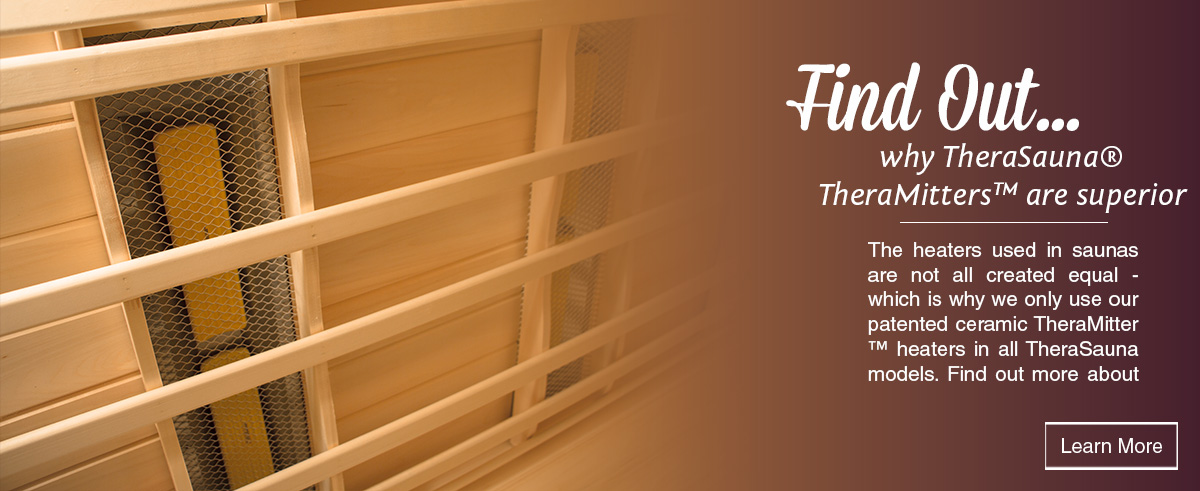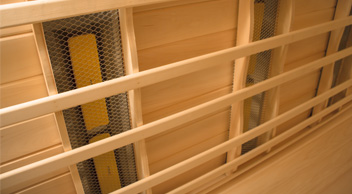
The best far infrared heating system is a solid Ceramic TheraMitter™ heater, because it is a proven system, while others like steel rod, aluminum, or carbon heating systems are touted as new technologies. The radiant efficiency of a heating material is an extremely important factor to its far infrared qualities. For this reason, ceramic TheraMitter™ remains the gold standard for producing the most vital micron range of infrared for the human body.
Compare for yourself and see why the TheraSauna® TheraMitter™ heaters provide the most effective range of far infrared therapy.
Concave Ceramic TheraMitter™
Ceramic is made from natural earth elements. TheraMitter™ heaters have the highest glass content in the industry which provides uninhibited transmission and output of far infrared. Concave Ceramic TheraMitter™ heaters are able to spread infrared heat waves in a 180º pattern, effectively covering every square inch inside the sauna. Due to the quality of the reflector, all energy is given direction toward the user to improve the delivery of far infrared. The absorbed heat characteristics of a ceramic TheraMitter™ produce an energy of feeling that creates well being and health due to the range of temperatures across the ribbed ceramic face. The EMF (Electromagnetic Field) is non-existent in the Ceramic TheraMitter™ due to the fact that the wire changes direction several times over the face of the heater, thus cancelling out any EMF. The watt density of the TheraMitter™ is ideal; providing the user with the highest output of far infrared at the most beneficial micron range for the human body.
Radiant Efficiency of Ceramic TheraMitter™: 96 %
Infrared Micron Range: 6.0 – 14.0
Incoloy Rod Heaters
Cylinder-type steel heaters are used by a number of different sauna companies. Tubular elements consist of a helical resistant wire inside a metal tube filled with magnesium oxide as an insulator and heat conductor. They have a radiant efficiency of 50% and emit an infrared wavelength range of 3.0 to 6.0 microns. Incoloy rod heaters have a short life span due to the compaction of the magnesium oxide which tends to short out the helical wire. They also have an extremely high watt density which produces a very high surface temperature of the rod, which in turn produces a lower ineffective range of infrared. The EMF of incoloy rod heaters is extremely high due to a non-cancelling wire and non-insulating metal surface.
Radiant Efficiency: 50%
Infrared Micron Range: 3.0 – 6.0
Tubular Ceramic Heaters
Tubular ceramic heaters consist of a helical resistant wire housed in vitreous silica sand enclosed in a metal tube. They have a radiant efficiency of 50% and emit an infrared wavelength range of 2.5 to 6.0 microns. Tubular ceramic heaters have a short life span due to the compaction of the silica sand which tends to short out the helical wire. They also have an extremely high watt density which produces a very high surface temperature of the rod, which in turn produces a lower ineffective range of infrared. The EMF of tubular ceramic heaters is extremely high due to a non-cancelling wire and non-insulating metal surface.
Radiant Efficiency: 50%
Infrared Micron Range: 2.5 – 6.0
Carbon Heaters
These heaters sandwich a carbon screen between two fiberglass epoxy resin casings. They operate at a very low surface temperature of 130º F and have a very low radiant efficiency. This type of heating element is used in automotive seat heaters. Carbon heaters tend to absorb odor, then re-emit the offensive odor back into the sauna. The carbon material has a very low watt density which makes it very difficult to completely heat the sauna to an adequate temperature. It also has an extremely high EMF which produces an unsafe environment.
Radiant Efficiency: 55% – varies
Infrared Micron Range: 4.0 – 20.0
Aluminum Heaters
These heaters are typically made by encasing incoloy heater rods inside aluminum sheets, which are then sprayed with a thin ceramic coating. This allows companies to make their heaters larger and give the impression they are ceramic. Aluminum heaters have a higher watt density which produces an ineffective micron range of infrared. Heat is produced from the back of the heater as well as the front which results in 50% of its heat energy wasted. These heaters also have a very high EMF which produces an unsafe environment.
Radiant Efficiency: 56%
Infrared Micron Range: 4.0 – 6.0
Does size of the infrared heater matter?
Our research has shown that physical size does not matter as much as the watt density of the heaters. The ideal infrared wavelength provided by the heaters within a far infrared sauna is more important than heater size. Some companies claim that large heaters are the best. The problem is that these large heaters have a very low watt density that produces an ineffective range of infrared and cannot heat the air inside the sauna effectively.